
How to Cook Live Mud Crab: The Complete Gold Coast Guide
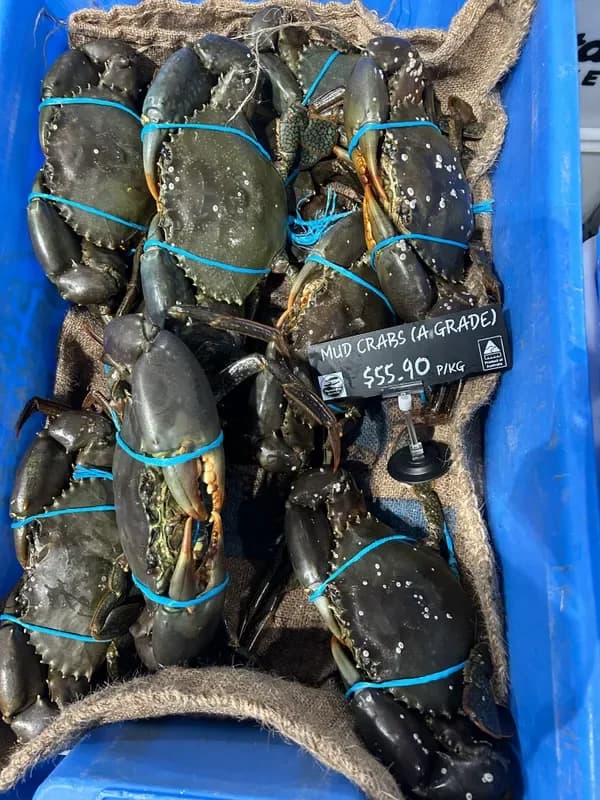
Quick answer: Sedate the live crab in the freezer for 30–45 minutes until unresponsive, spike it through both nerve centres, then boil in well-salted water (35g salt per litre): 8 minutes for the first 500g plus 5 minutes per extra 500g. A 1kg crab takes ~13 minutes. It's done when the shell is deep orange-red and the meat is opaque white. Plunge into iced water, then serve.
Key facts:
- Sedate the crab first: 30–45 min in the freezer, or 20 min in an ice slurry, until unresponsive
- Boiling time: 8 minutes for the first 500g + 5 minutes per additional 500g
- A 1kg mud crab takes about 13 minutes to boil; a 1.5kg crab about 18 minutes
- Cook in salted water (~35g salt per litre) or clean seawater for the sweetest meat
- Done when the shell is deep orange-red and internal temperature reaches 70°C
- Mud crab yields ~30–35% edible meat; allow one 600–800g crab per person
- Always buy mud crab live and cook it the same day, it deteriorates fast once dead
Why Mud Crab Is Worth Doing Properly
Queensland mud crab (Scylla serrata) is one of the best eating crabs in the world: dense, sweet, faintly nutty meat in claws thick enough to need a cracker. On the Gold Coast it's a celebration food: chilli crab, crab in XO sauce, or simply cracked with lemon and good bread.
But it's also a live product, and that brings two responsibilities: cooking it humanely, and cooking it on the day so the meat is perfect. Get those two right and the rest is easy.
This guide covers the humane dispatch method, exact cooking times by weight, boiling vs steaming, and how to know when it's done.
Before You Cook: Buying and Holding a Live Mud Crab
A good live mud crab is heavy for its size, actively moving, and tightly closed. A light crab has recently moulted and the shell is half-empty. Press the shell. It should be hard, not papery.
Keep the crab alive and calm until you cook it:
- Store in the fridge crisper (around 4–8°C) covered with a damp hessian sack or wet newspaper
- Keep the claws banded
- Do not submerge in fresh water or sit it in a sealed bag, both will kill it
- Cook the same day you buy it for the best meat
For the full holding method, see our guide on how to keep live crabs alive before cooking.
Tasman Star sells live Queensland mud crab at both Gold Coast stores, graded by size, hard-shelled and full. Browse live seafood or call Varsity Lakes on (07) 5522 1221 to check the day's stock.
Step 1: Sedate the Crab (the Humane First Step)
This is the step most home cooks skip, and it's the most important one. Dropping a fully conscious crab into boiling water is both inhumane and produces worse food. The crab thrashes and sheds its legs, losing meat.
The RSPCA-recommended approach is to render the crab insensible by chilling, then dispatch it physically:
| Method | Time | Notes |
|---|---|---|
| Freezer | 30–45 minutes | Easiest at home; check it's fully unresponsive before proceeding |
| Ice slurry (ice + water) | ~20 minutes | Faster; fully submerge the crab |
The crab is ready when it does not respond at all when you touch its eyes or legs. Chilling sedates. It does not reliably kill. That's why the next step matters.
Step 2: Dispatch the Crab
Once the crab is unresponsive, dispatch it by spiking through both nerve centres. A mud crab has two:
- Front centre: under the triangular flap at the head/mouth end
- Rear centre: under the pointed tail flap folded against the underside
Flip the crab onto its back, lift each flap, and drive a sturdy, pointed knife or a dedicated crab spike straight down into each spot, moving the blade to destroy the ganglion. Done correctly the legs relax immediately.
This is the method recommended for two-nerve-centre crustaceans like mud crab and is quicker and more reliable than relying on boiling alone.
Step 3: Boiling Mud Crab (Times by Weight)
Boiling is the most reliable method, especially for larger crabs.
- Bring a large pot of well-salted water to a rolling boil, about 35g of salt per litre (a heaped tablespoon), or use clean seawater. You want enough water to fully submerge the crab.
- Lower the dispatched crab in. The water will drop off the boil, so bring it back up and start timing from when it returns to the boil.
- Cook by weight:
| Crab weight | Boiling time |
|---|---|
| 500g | 8 minutes |
| 750g | ~10–11 minutes |
| 1kg | ~13 minutes |
| 1.5kg | ~18 minutes |
| 2kg | ~23 minutes |
The formula: 8 minutes for the first 500g, then +5 minutes for every additional 500g. Don't overcook: past the mark the meat turns stringy and dry.
Step 4: Steaming Mud Crab (Sweeter Meat)
Steaming keeps every bit of flavour in the meat instead of leaching it into the water, so the result is noticeably sweeter and less watery.
- Set up a steamer with a few centimetres of salted water below the basket; bring to a vigorous boil.
- Place the dispatched crab in the basket, cover, and steam.
- Times run a little longer than boiling:
| Crab weight | Steaming time |
|---|---|
| 500g | 12 minutes |
| 1kg | ~18 minutes |
| 1.5kg | ~24 minutes |
The formula: 12 minutes for the first 500g, then +6 minutes per additional 500g.
For crabs over 1.2kg, boiling cooks more evenly all the way to the centre; for smaller crabs, steaming is the connoisseur's choice.
How to Tell When Mud Crab Is Cooked
Three reliable signs:
- Colour: the whole shell turns a deep, even orange-red. A patchy brownish-orange means it needs more time.
- Meat: pull a leg away; the meat inside should be opaque white, not glassy or translucent, and should not cling stubbornly to the shell.
- Temperature: a probe at the thickest part of the body reads 70°C.
Step 5: Cool, Crack, and Serve
Plunge the cooked crab into iced water for 2–3 minutes. This stops residual cooking and firms the meat so it releases cleanly from the shell.
To serve:
- Twist off the claws and legs; crack the claws with the back of a heavy knife or a crab cracker
- Lift off the top shell (carapace); remove and discard the feathery grey gills ("dead man's fingers") and the stomach sac behind the eyes
- Cut the body in half to expose the body meat
For step-by-step cleaning and meat-picking, see how to clean and prepare crab.
Serve simply with lemon wedges, crusty bread, and a bowl for shells, or build it into a chilli crab or a garlic-butter bake.
How Much Mud Crab Per Person?
| Serving style | Amount per person |
|---|---|
| Main course (crab the hero) | One 600–800g crab |
| Shared, as part of a seafood spread | One 1–1.2kg crab between two |
| Asian banquet (chilli/XO crab, multiple dishes) | 400–500g crab per person |
Mud crab yields about 30–35% edible meat, so a 1kg crab gives roughly 300–350g of picked meat.
Buying Live Mud Crab on the Gold Coast
Tasman Star Seafood stocks live Queensland mud crab graded by size at both stores:
- Varsity Lakes: 20 Casua Dr, (07) 5522 1221
- Labrador: 5–7 Olsen Ave, (07) 5529 2500
Because mud crab must be bought live, call ahead to confirm size and availability, especially for large crabs or multiple crabs for an event. Home delivery runs 7 days a week across the Gold Coast.
→ Not sure which crab to buy? Read mud crab vs sand crab vs spanner crab to choose the right one for your dish.
Written by
The Tasman Star Team · Gold Coast fishmongers
Articles from the fishmongers at Tasman Star Seafood. We source, fillet and sell fresh seafood on the Gold Coast seven days a week, sharing seafood buying guides, cooking ideas and practical information for our customers.
Fresh seafood delivered to your door
Order live mud crabs online from Tasman Star Seafood, Gold Coast delivery Monday to Saturday.
More Seafood Articles
How to Build a Seafood Platter for 2, 4, 6, 10 or 20 People
Seafood platter quantities that actually work: grams per person, a shopping list for 2 to 20 guests, and how a $200 Father's Day spend unlocks free merch online or in store.
GuidesIs Flake Shark? What Australian Fish and Chip Shops Actually Sell
Yes. Flake is shark, usually gummy shark. It is mild, boneless and common in fish and chips. Here is the species table, the mercury note, and what to cook instead.
GuidesWhat Is Mullet Roe? Bottarga, Fresh Roe and How Australians Eat It
Mullet roe is the egg sack of sea mullet. Fresh, it fries crisp. Cured, it is bottarga. Same fish as Mediterranean grey mullet. A Gold Coast guide to buying, curing and cooking it.